Having exchanges left does not mean every Aniimo can be traded. Each player has five daily exchanges, but high Acquired Potential uses tighter counters, and your Affinity with the particular friend decides which Aniimo can enter the exchange at all.
These restrictions answer different questions. The five-attempt balance asks whether you can complete another exchange. The high-Potential counters ask whether you have already used today's allowance for that stat value. Affinity asks whether this friend relationship permits the creature's stage, form and Acquired Potential.
- Daily exchanges
- Five per player
- High-stat allowances
- One each for 8, 9 and 10
- First unlock
- 100 Affinity
- Re-exchange lock
- 30 days
The daily five and the high-stat counters both apply
For an Aniimo whose highest Acquired Potential is 8, 9 or 10, the corresponding value has a one-per-day allowance across your friends. Trading with another friend does not create a fresh allowance for the same value.
For example, after completing an exchange involving a highest value of 8, you cannot use the remaining general attempts to move a second highest-8 Aniimo that day. Your 9 and 10 allowances are separate, provided the next pairing also meets its friendship requirements.
The number here is Acquired Potential on an individual stat. It is not the Aniimo's level, the sum of its stats or the overall Perfect Potential tier. The Potential guide explains those separate parts of a profile.
Consider this hypothetical daily plan, with all friendship and creature restrictions satisfied on both sides:
| Exchange | Highest value | Allowance used |
|---|---|---|
| 1 | 8 | Today's 8 |
| 2 | 9 | Today's 9 |
| 3 | 10 | Today's 10 |
| 4 | 7 or less | General attempt |
| 5 | 7 or less | General attempt |
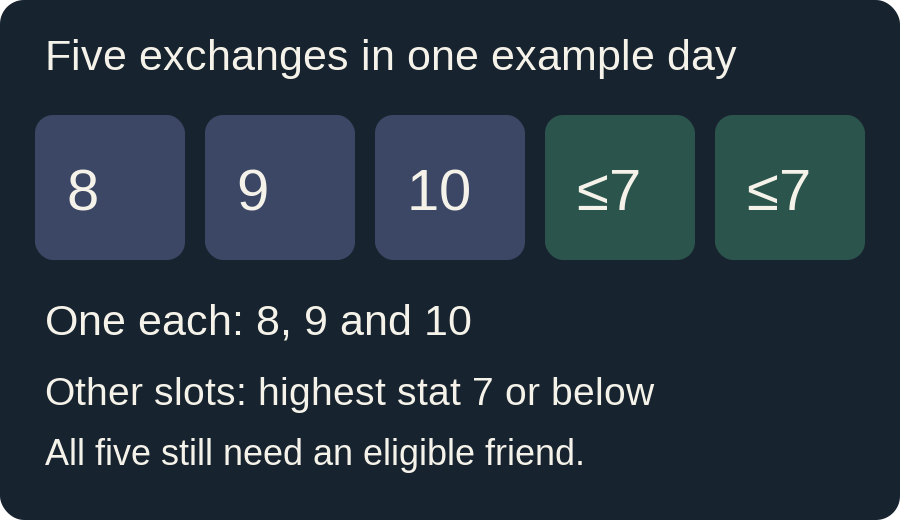
This is an allowance example, not a promise that a particular friend can complete the whole sequence with you. Your friend has their own daily balance and high-stat restrictions. An exchange can stop because either player has exhausted the relevant allowance, even when your own screen still shows general attempts remaining.
Affinity with that friend sets the creature's eligibility
The first exchange opens at Good Friend, 100 Affinity. Initially the scope is Common Aniimo in Lumin Stage and Basic Form, with no stat above 8 Acquired Potential. A newly added friend at Level 1 has no exchangeable Aniimo yet.
| Level (Affinity) | Eligible scope | Cap |
|---|---|---|
| 2 (100) | Common, Lumin, Basic | 8 |
| 3 (500) | Common, any stage, Basic | 8 |
| 4 (1,200) | Common or Umbral; Basic, Region, Weather | 9 |
| 5 (2,500) | Same forms as Level 4 | 10 |
“Any stage” means Lumin, Gamma or Nova. Thus an evolved Common Basic-form Rookey needs the Level 3 scope, while a Lumin Basic Pawney can fit Level 2, assuming its individual stats and other restrictions also qualify. The species name alone does not settle the exchange.


At Level 4, the cap rises to 9 and Umbral, Region and Weather forms enter the listed scope. Level 5 raises the cap to 10. A Level 4 relationship still cannot accept an Aniimo with a stat at 10, regardless of how many general attempts both players have banked.
Level 6, Soulmate at 4,500 Affinity, does not add a higher stat cap or a broader exchange-form list. Friendship progression matters, but it is not a universal permission to trade every rare form.
A Prismana or Sparkling copy does not fit the ordinary list
The exchange list covers Common and Umbral Aniimo. Sparkling, Alpha and Illusory copies are absent from that list, and Prismana Form has no qualifying exchange tier. Raising the relationship to Best Friend does not add those missing entries.
That matters when coordinating with someone who owns an appearance you want. A friend's rare creature may be useful for a visit or another shared activity without being an eligible trade. In particular, an offer to “send my Prismana over once we reach 2,500” is not supported by the exchange scope.
An otherwise eligible individual also needs to be available: an Aniimo in a party, at Home or on a dispatch must be removed from that assignment before it can be offered. A locked selector entry can therefore be an assignment problem, separate from either Affinity or daily limits. The full trading guide includes the species exclusions and the wider friendship system.
The received Aniimo cannot immediately travel through a third player
After an Aniimo is exchanged, that individual cannot be exchanged again for 30 days. The receiver's unused daily attempts do not erase the creature's lock.
Suppose Alice sends an eligible Fentuft to Ben. Ben cannot pass that same Fentuft to Cara later that evening, even if Ben has four daily exchanges left and enough Affinity with Cara. The first exchange has placed the received individual under the 30-day restriction.
The same issue affects a proposed immediate return: “trade it to me and I will send it straight back” asks the second exchange to ignore the lock. A different eligible individual and the received one are different cases; keeping a spare does not make the locked copy transferable.
Agree on the intended recipient before the exchange. Daily attempts govern how often you can trade today, friendship governs what the pair can trade, and the received creature's cooldown governs when it can move again. None of the three balances replaces the others.