
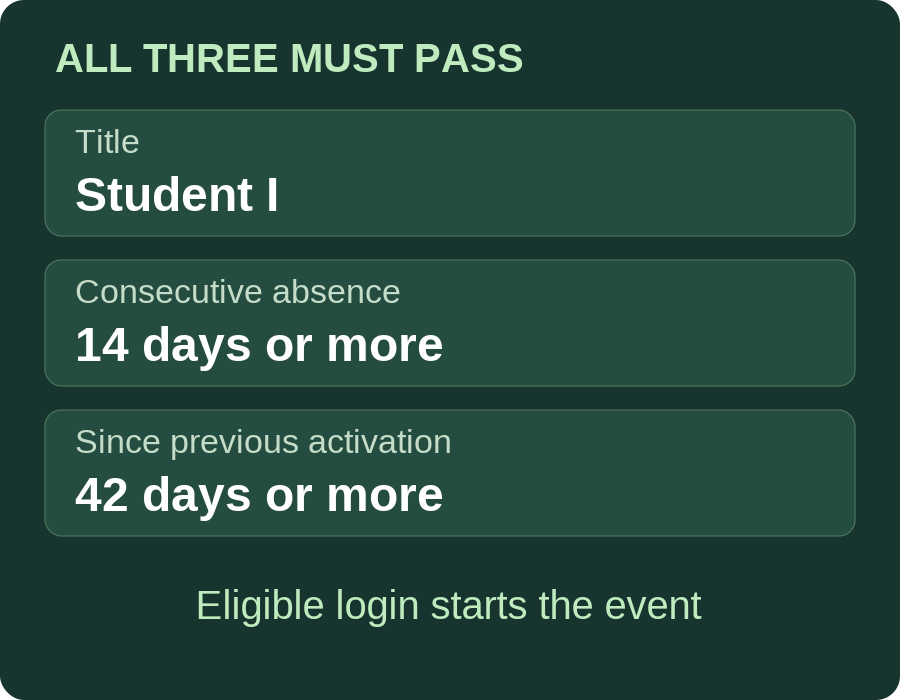
Fourteen days away is only one of Return to Idyll's three eligibility conditions. The version announced for the November 26 update also requires Student I and at least 42 days since the event's previous activation. A player can satisfy the absence requirement while still being too early to reactivate it.
The event starts automatically when an eligible Pathfinder logs in. Its rewards and shared party bonuses then follow that personal activation, rather than one global countdown for every returning account. These are the announced November 26 rules, ahead of the update.
- Minimum title
- Student I
- Consecutive absence
- At least 14 days
- Since last activation
- At least 42 days
- Named egg threshold
- 1,350 Reunion Tokens
The absence clock and the reactivation clock must both pass
The conditions are cumulative. Student I, fourteen consecutive days without a login and forty-two days since the last activation all have to be satisfied. The longer clock is measured from the event's activation, not from when its previous reward window ended.
Take three hypothetical players who already hold Student I and have an earlier activation on record:
| Absence / since activation | Result |
|---|---|
| 14 days / 35 days | Too early on the 42-day clock |
| 13 days / 42 days | Absence still short |
| 14 days / 42 days | Both time conditions met |
These examples show why “I have been away for two weeks” does not settle eligibility by itself. A player below Student I still fails the title condition even when both time intervals are long enough.
The progression guide separates titles from Pathfinder levels. Return to Idyll names a title here; an impressive creature level or RV level does not replace Student I.
Your login starts the window, and the 30-day tier is a reward distinction
Once an eligible player logs in, Return to Idyll activates automatically and ends at 04:00 on the fifteenth day after activation. The notice gives a service-clock boundary. It does not describe an unrestricted timer of fifteen full 24-hour periods after whatever minute you return.
That matters for a late-night return. The meaningful endpoint is the event's numbered day and 04:00 boundary, rather than adding 360 hours to the moment you opened the client. The reset timers separate the regional service clocks from your own local time.
7-Day Gift provides daily login rewards during the event. Its two reward tiers depend on whether the absence was 14 days or 30 days. Thirty days is a higher reward-tier distinction, not the minimum absence needed for the entire event.
A player away for fourteen days can therefore qualify for the announced system, provided the other two gates also pass. The thirty-day tier does not waive the title requirement or the separate forty-two-day gap. Those conditions answer whether the event starts; the absence tier answers which login-reward tier applies.
The named egg comes at 1,350 Reunion Tokens
Return Journey tasks award Reunion Tokens and a Double-Cost Ticket (7 Days). Reaching the required token amounts grants Glimmer, while 1,350 Reunion Tokens awards an additional Prismana Egg of Choice ×1.

For a hypothetical return track with 1,000 tokens earned, the gap to that named egg is 350 tokens. That arithmetic identifies remaining progress. It is not a claim that one more task, one more login or a fixed number of days always supplies those 350.
The egg's identity is the useful reward promise here: one Prismana Egg of Choice. It is separate from the daily login packages, the Glimmer milestones and the seven-day ticket. The announcement does not identify its complete choice pool or give it an additional Perfect Potential guarantee.
The egg reward comparison explains why a form promise, a choice and a Potential guarantee should be read separately. Return Journey's named threshold should not be silently rewritten as any other egg simply because a different event used a similar-looking reward.
The Double-Cost Ticket (7 Days) is also a separate named task reward. Its presence does not turn every Return Journey payout into a doubled amount, nor change the 1,350-token milestone into 675.
Returning and new-player party bonuses do not stack
Reunion Blessing lets a returning Pathfinder and their teammates share three bonuses when grouped together:
| Eligible interaction | Announced increase |
|---|---|
| Friends' Companion Mode Reports | 20% |
| Friends' shared Prismatic Energy | 20% |
| Catch success in Companion Mode | 10% |
The activity names set the scope. A bonus to friends' shared Prismatic Energy is not an EXP boost for every task, and the catching bonus is specifically for Companion Mode.
More than one returning Pathfinder does not stack the buff. The same is true when a party includes both a new and a returning Pathfinder: their bonuses are identical and do not stack. Two returning players do not produce a forty-percent report bonus; adding a new-player mark does not create a second copy of the returner's catching bonus.
For a hypothetical eligible report reward of 1,000, one twenty-percent increase makes 1,200. Adding another returning teammate does not turn it into 1,400 or apply another multiplier to reach 1,440. Those are illustrative starting values, not a payout promise for a particular catch.
The Freshly Hatched Partner article covers the new-player system's separate level and seven-day rules. Return to Idyll supplies another qualifying party member for the shared activities, while keeping its own absence, reactivation and personal reward conditions.