Finding a better member of a family you already trained does not mean paying to build its training from scratch. Inherit costs 20,000 Credits and moves the eligible training profile onto the replacement. Both Aniimo remain in your Collection, but the old companion receives the replacement's former profile.
That last part matters if you still use the original. You are moving an investment between companions. Afterward, the recipient carries the developed profile and the source no longer has that same training available for another team.
- Transfer fee
- 20,000 Credits
- Ordinary pairing
- Same family
- Profile direction
- Left to right
- Creatures consumed
- None
The fee moves a package, not just the level
Inherit covers EXP, level, Resonance stage, Star Rank, Capability Awakening and Capafruit, together with the other included training progress. Capafruit effects transfer automatically. Surplus growth items are returned.
You cannot ask the operation to send only the level while leaving the rest of that profile behind. Before moving a well-developed companion, compare its Resonance and Awakening investment as well as the number beside its name.
| Part of the profile | Result of Inherit |
|---|---|
| EXP and level | Move with the training profile |
| Resonance stage and Star Rank | Included in the transfer |
| Capability Awakening | Training progress transfers |
| Capafruit | Effects transfer automatically |
| Surplus growth items | Returned |
The charge is Credits, not Home Coins. Paying it also does not purchase a new innate roll, a new form or an evolution. Those are separate reasons to choose one individual over another.
The Potential guide explains the difference between an individual's innate attributes and its development. Inherit is useful when you have found the individual you prefer and want your existing training investment working on that companion.
Pawney and Rookey show why the source gets weaker
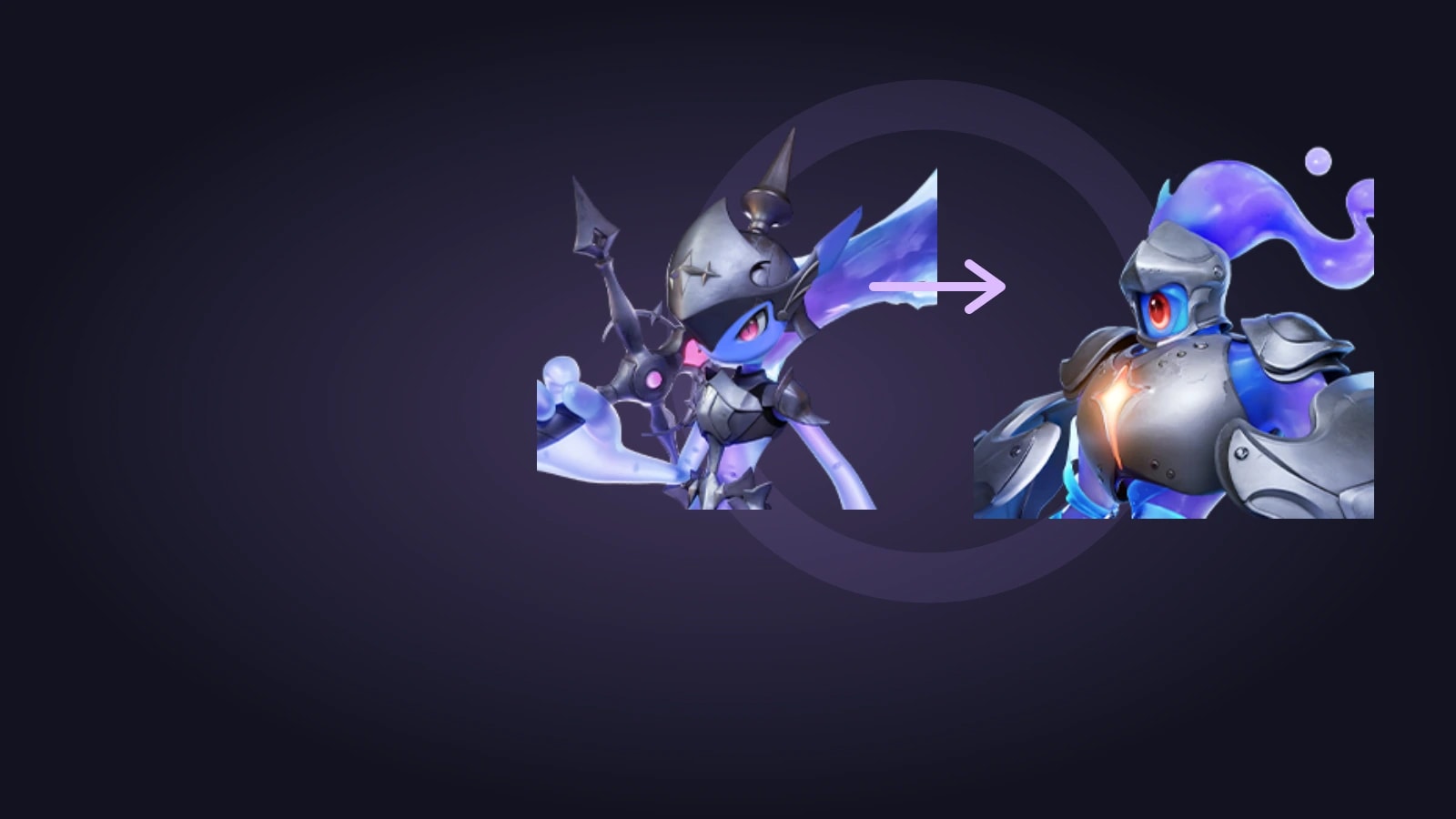
The established Inherit walkthrough uses Pawney at Lv 55 and Rookey at Lv 45. After the transfer, Rookey has the Lv 55 profile and Pawney has the Lv 45 profile. Neither creature disappears.

| Individual | Before | After |
|---|---|---|
| Pawney, the source | Lv 55 | Lv 45 |
| Rookey, the recipient | Lv 45 | Lv 55 |
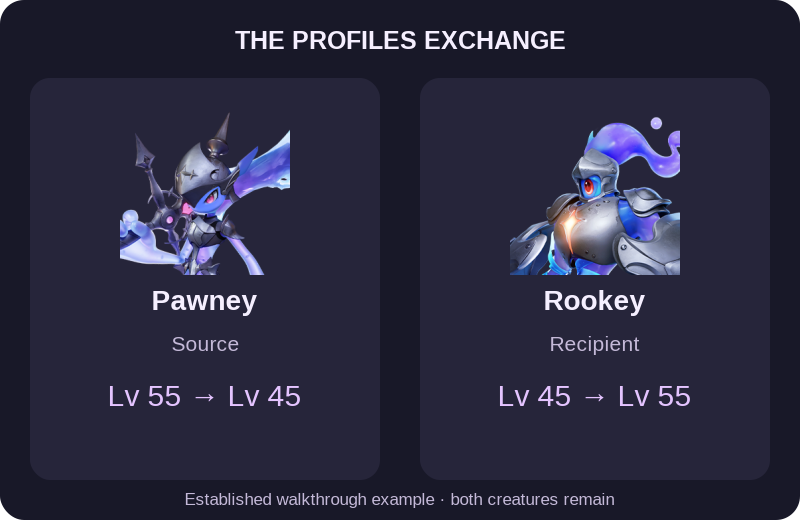
The practical consequence is easy to miss when the confirmation emphasizes the recipient: the source remains yours, but it is no longer the trained version you just moved away. If Pawney was filling a combat slot, its post-transfer level is now 45 in this example. Keeping both creatures does not preserve two copies of the Lv 55 investment.
That makes Inherit a replacement decision. It is useful for shifting the developed role onto a preferred catch, while keeping the original individual for collection or later use. It does not instantly build a second equally developed party member.
Pick the individual first, then match the family
The usual restriction is the same family, which includes different evolution stages. Pawney, Rookey and Helmut belong to one family, so an identical species name is not the only valid pairing.

Your recipient keeps its own identity. Training does not turn Rookey into Pawney or copy the source's personality and appearance onto it. If the new catch is valuable because of those individual properties, the point of transferring is to develop that catch while retaining them.
Basic Irisalis has a special role as the source: it can pass the family check with a different-family recipient. This exception does not remove the other eligibility restrictions. It is not a rule that any two unrelated Aniimo can exchange training, or that putting Irisalis on either side always works.

The keeper comparison helps separate the individual you want from the resources already spent on another one. Compare those questions before committing the transfer: which catch is the keeper, and which profile should it receive?
A missing selector entry can be an exploration assignment
An Aniimo in a prepared combat roster or exploration roster cannot be selected for Inherit. Removing it from the fighting team alone may leave the exploration assignment in place. Check both the source and recipient, including the companion assigned to traversal.
An eligible training difference is also required. A source being higher level does not, on its own, establish that the pair passes every profile check. If a pair remains unavailable after clearing roster assignments, compare its developed training rather than spending random materials just to make the level gap larger.
Once the pair is eligible, the source goes on the left and the recipient on the right. The final payment prompt is the commit point. Read both individuals and the 20,000-Credit charge there, particularly when several copies share the same species name.
Afterward, inspect both profiles. The intended recipient should carry the transferred training, and the source should remain in the Collection with the recipient's previous profile. That two-sided result is what turns a better catch into a replacement without another full training bill.