


Innate Potential and developed Potential
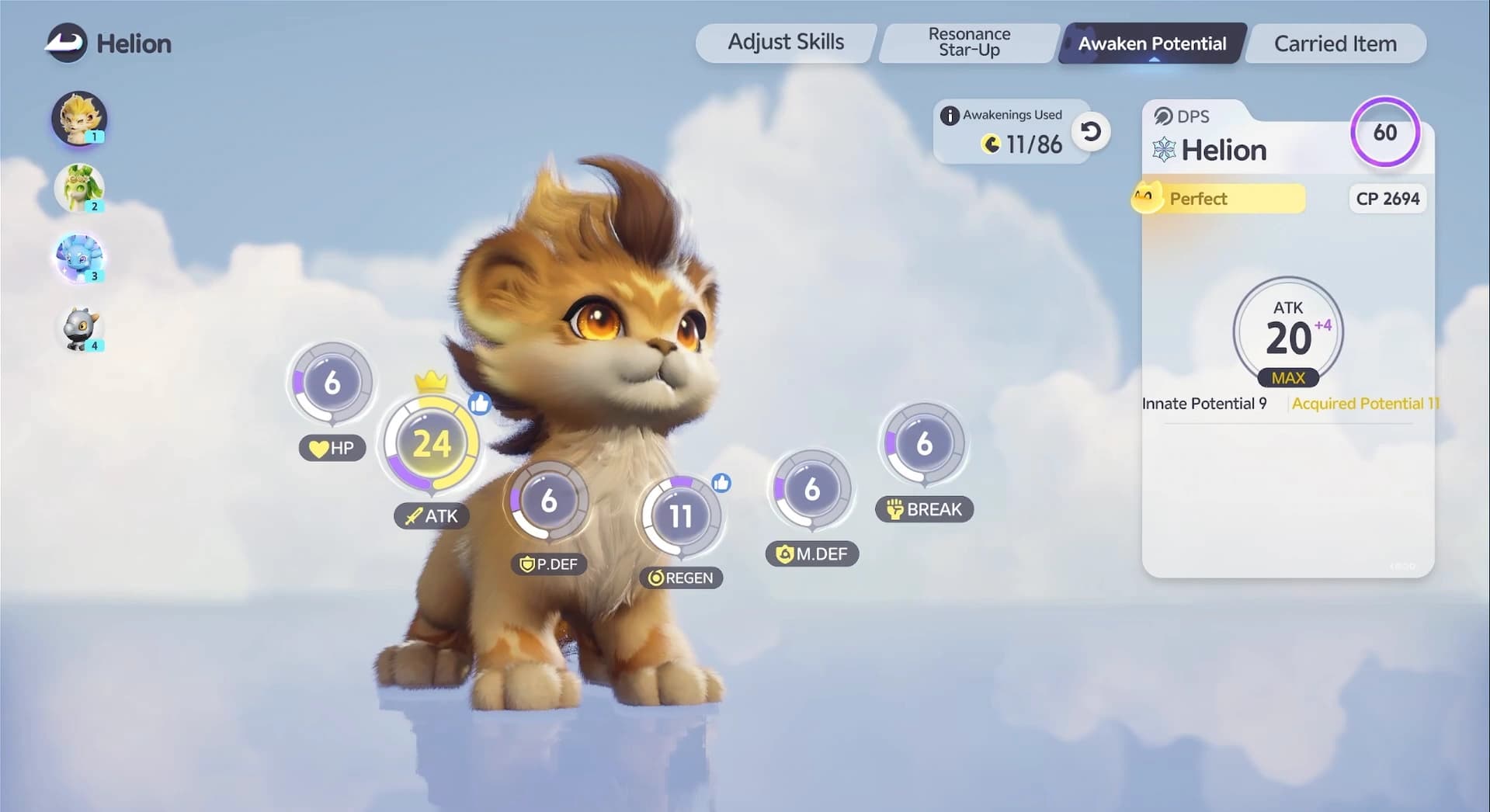
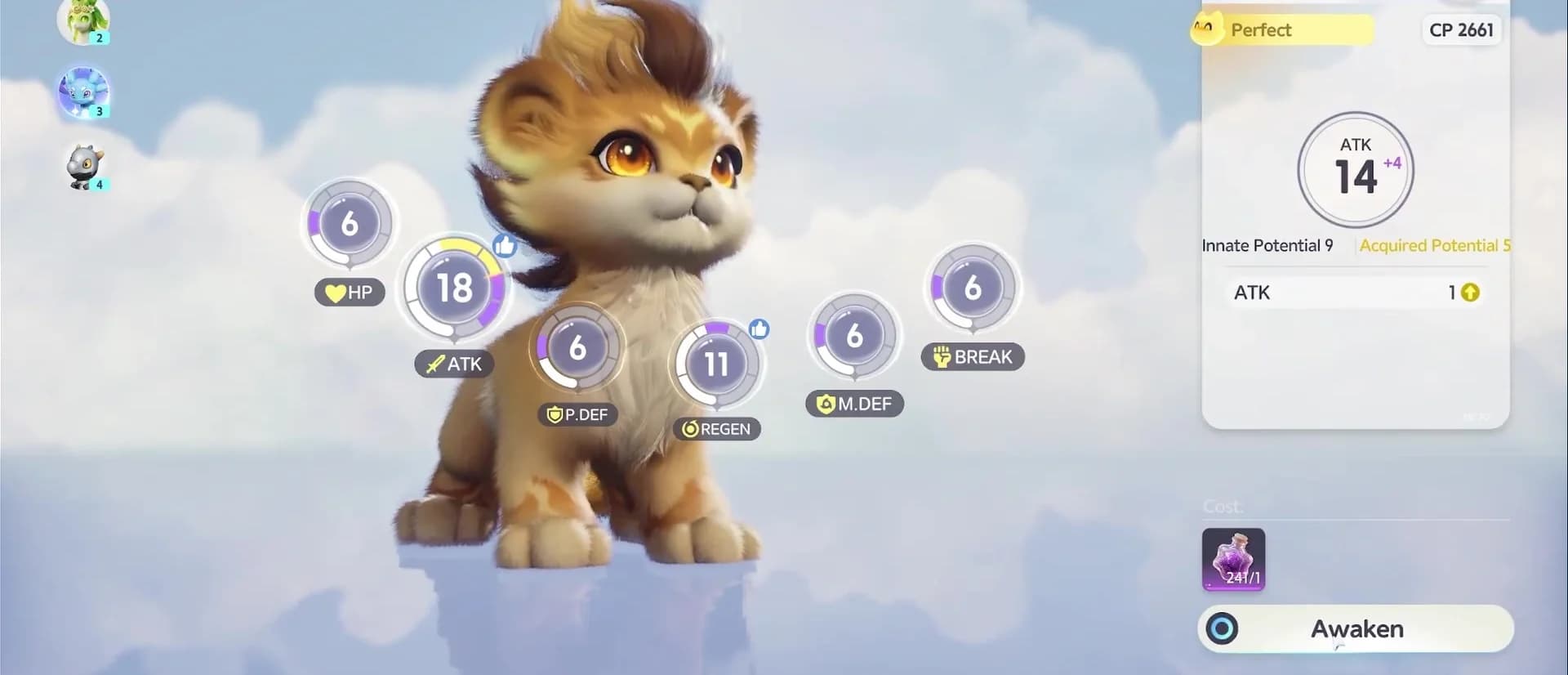
Innate Potential is fixed at birth and is what the Research Console grades when you report a catch. Acquired Potential is added afterwards through Capability Awakening, and the two of them added together are capped at 20 on every attribute, so a weak roll and a strong roll finish at the same ceiling and only differ in what the climb costs.
One attribute
- Innate Potential
Where it comes fromRolled the moment the Aniimo is caught, hatched or received
What you can do about itOnly Capafruit moves it, and only once per Aniimo
- Acquired Potential
Where it comes fromBought a point at a time through Capability Awakening
What you can do about itRaise it whenever you have the materials and the allowance
- The 20 ceiling
Where it comes fromInnate plus Acquired on that one attribute
What you can do about itIdentical for every Aniimo, every rarity and every grade
- Everything above the line
Where it comes fromResonance, Held Items, traits and level
What you can do about itStacks on top of the 20 and is shown separately in the panel
The six attributes are HP, ATK, P.DEF, M.DEF, BREAK and REGEN. Two of them carry a recommended marker on the Aniimo you are looking at, and those two are the ones the appraisal grade weighs most heavily. Personality and traits are a separate layer again, covered in the Personality guide.
What the Common, Good, Elite and Perfect ratings mean
Reporting a catch at an outpost Research Console converts its six Innate Potential values into one Potential score out of 100, weighted towards the two recommended attributes, and prints a rating. The bands are fixed.
| Rating | Potential score | Chance from an ordinary wild catch |
|---|---|---|
 Common Common | Under 32 | 66% |
 Good Good | 32 to 47 | 26% |
 Elite Elite | 48 to 63 | 7.2% |
 Perfect Perfect | 64 and above | 0.8% |
The highest score any roll produces is 80, so Perfect is a band rather than a single result: most Perfect catches land on exactly 64 and the scores above it get rare very quickly. That is the whole reason players compare two Perfect Aniimo and find one clearly better.
Odds of a Perfect Aniimo from each catch source
The roll is on the source, not on the species, and four sources use four different tables. Everything in the open world that is not an Alpha and not Umbral uses the first row.
| Source | Common | Good | Elite | Perfect |
|---|---|---|---|---|
| Ordinary wild Aniimo | 66% | 26% | 7.2% | 0.8% |
| Alpha Aniimo | None | 80% | 18.6% | 1.4% |
| Aniimo drawn by ecosystem nurturing | 56% | 34% | 9% | 1% |
| Umbral Aniimo | None | None | None | 100% |
In plain numbers: an ordinary wild Aniimo is a Perfect roll about 1 catch in 125, an Alpha is about 1 in 71, and an Aniimo pulled out of a nurtured Vein gathering is about 1 in 100. Nurturing an ecosystem before you hunt also strips the Common band from 66% down to 56%, which matters far more day to day than the Perfect line does. Alphas are the strongest free filter of the three, because they cannot roll Common at all.

Every Capability Awakening cost, point by point
One Capability Awakening buys exactly one point of Acquired Potential on the attribute you selected. It never fails and there is no chance roll, so the only question is what the next point costs. The price is set by the number the attribute is climbing to, not by the Aniimo, the species or the rating: the 20 rungs below are identical for every Aniimo family in the game.
- 10 Star Dust
 Potential 1 to 4
The first four points cost Star Dust and rise 1, then 2, then 3, then 4.
- 10 Star Sand
 Potential 5 to 8
Point 5 steps up to Star Sand, and the same 1, 2, 3, 4 curve runs again.
- 10 Starcryst Essence
 Potential 9 to 12
Point 9 steps up to Starcryst Essence and climbs 1, 2, 3, 4 for the third time.
- 40 Starcryst EssencePotential 13 to 20
Every point from 13 upwards is a flat 5 Starcryst Essence, eight times over.
| Potential reached | Material | Quantity | Cumulative Dust / Sand / Essence |
|---|---|---|---|
| 1 | Star Dust | 1 | 1 / 0 / 0 |
| 2 | Star Dust | 2 | 3 / 0 / 0 |
| 3 | Star Dust | 3 | 6 / 0 / 0 |
| 4 | Star Dust | 4 | 10 / 0 / 0 |
| 5 | Star Sand | 1 | 10 / 1 / 0 |
| 6 | Star Sand | 2 | 10 / 3 / 0 |
| 7 | Star Sand | 3 | 10 / 6 / 0 |
| 8 | Star Sand | 4 | 10 / 10 / 0 |
| 9 | Starcryst Essence | 1 | 10 / 10 / 1 |
| 10 | Starcryst Essence | 2 | 10 / 10 / 3 |
| 11 | Starcryst Essence | 3 | 10 / 10 / 6 |
| 12 | Starcryst Essence | 4 | 10 / 10 / 10 |
| 13 | Starcryst Essence | 5 | 10 / 10 / 15 |
| 14 | Starcryst Essence | 5 | 10 / 10 / 20 |
| 15 | Starcryst Essence | 5 | 10 / 10 / 25 |
| 16 | Starcryst Essence | 5 | 10 / 10 / 30 |
| 17 | Starcryst Essence | 5 | 10 / 10 / 35 |
| 18 | Starcryst Essence | 5 | 10 / 10 / 40 |
| 19 | Starcryst Essence | 5 | 10 / 10 / 45 |
| 20 | Starcryst Essence | 5 | 10 / 10 / 50 |
Taking one attribute from 0 to 20 therefore costs 10 Star Dust, 10 Star Sand and 50 Starcryst Essence. Taking all six from a zero roll costs 60 Star Dust, 60 Star Sand and 300 Starcryst Essence. Read the ladder the other way and it explains why a good roll is worth chasing: the first 8 points of an attribute are the entire Star Dust and Star Sand bill, so an Aniimo that starts at 8 Innate in a stat pays none of it, while the 50 Starcryst Essence above point 8 is the same bill for everyone.
Where Star Dust, Star Sand and Starcryst Essence come from
All three materials come out of the same handful of systems, and the cheap one converts upward. Alpha Aniimo are the reliable free source of the lower two grades, and Omega encounters are where the top grade appears.
| Material | Free sources | Bought with |
|---|---|---|
 Star Dust Star Dust | Defeating Alpha Aniimo, Elite Training rewards, Pathfinder Challenge, level rewards, Companion Handbook | 6,400 Credits at the Mysterious Vendor, 20 a day. 4 Voxel Coin at Coilstrike Club, 50 in total. 20 Windborn Stamps for 5 at the Badge Shop, 10 a week |
 Star Sand Star Sand | The same Alpha, Elite Training, Pathfinder Challenge and Companion Handbook rewards as Star Dust | 5 Star Dust at the outpost Item Exchange. 32,000 Credits at the Mysterious Vendor, 5 a day. 20 Voxel Coin at Coilstrike Club, 20 in total |
 Starcryst Essence Starcryst Essence | Defeating Omega Aniimo, Elite Training, Holo-Battle Interlink, Holo-Battle Sim, level rewards | 10 Star Shard at the outpost Item Exchange. 600,000 Credits at the Mysterious Vendor, 2 a day. 100 to 300 Windborn Stamps per bundle at the Badge Shop |



Star Shard only drops from Omega encounters and does nothing on its own: 10 of them exchange for 1 Starcryst Essence at an outpost vendor, so never scrap them. The Alpha reward chest costs 30 Primegy to claim and pays Starcryst Essence and Star Shard; the Omega chest costs 50 Primegy and is where Capafruit and Capaseed come from.

Capafruit: what it does and who should eat it
Capafruit grants +1 Innate Potential to each of an Aniimo’s six attributes, and each Aniimo can consume exactly one, ever. It is the only thing in the game that moves Innate Potential after the catch, and it lands on all six attributes rather than only on the two the panel marks as recommended.
Capafruit comes from Elite Training rewards, the Companion Handbook Advanced Edition, the Season Badge Shop at 300 Windborn Stamps, the Mysterious Vendor at 2,000,000 Credits with a cap of 1 a day, and the Omega chest. The slow free route is Capaseed, which drops from catch completion, Elite Pathfinder Challenges, level rewards and the Vein’s Nurture Branch: 20 Capaseeds exchange for 1 Capafruit at an outpost vendor.
Resets, evolution, Inherit and trading
Acquired Potential is not permanent, but the escape hatch closes. Resetting an Aniimo’s Acquired Potential costs 200,000 Credits and returns every material you spent, and it is blocked once the Aniimo reaches level 61. The training level cap is 60, so the refund is available for the whole time an Aniimo is still growing, which is why experienced players tell beginners to spend early instead of hoarding.
You evolve it, or change its form
The individual does not change, only its shape and its stat curve
Innate and Acquired Potential both carry over untouched, so developing a first-stage Aniimo is never wasted work.
You Inherit into a better individual
A same-family transfer for 20,000 Credits
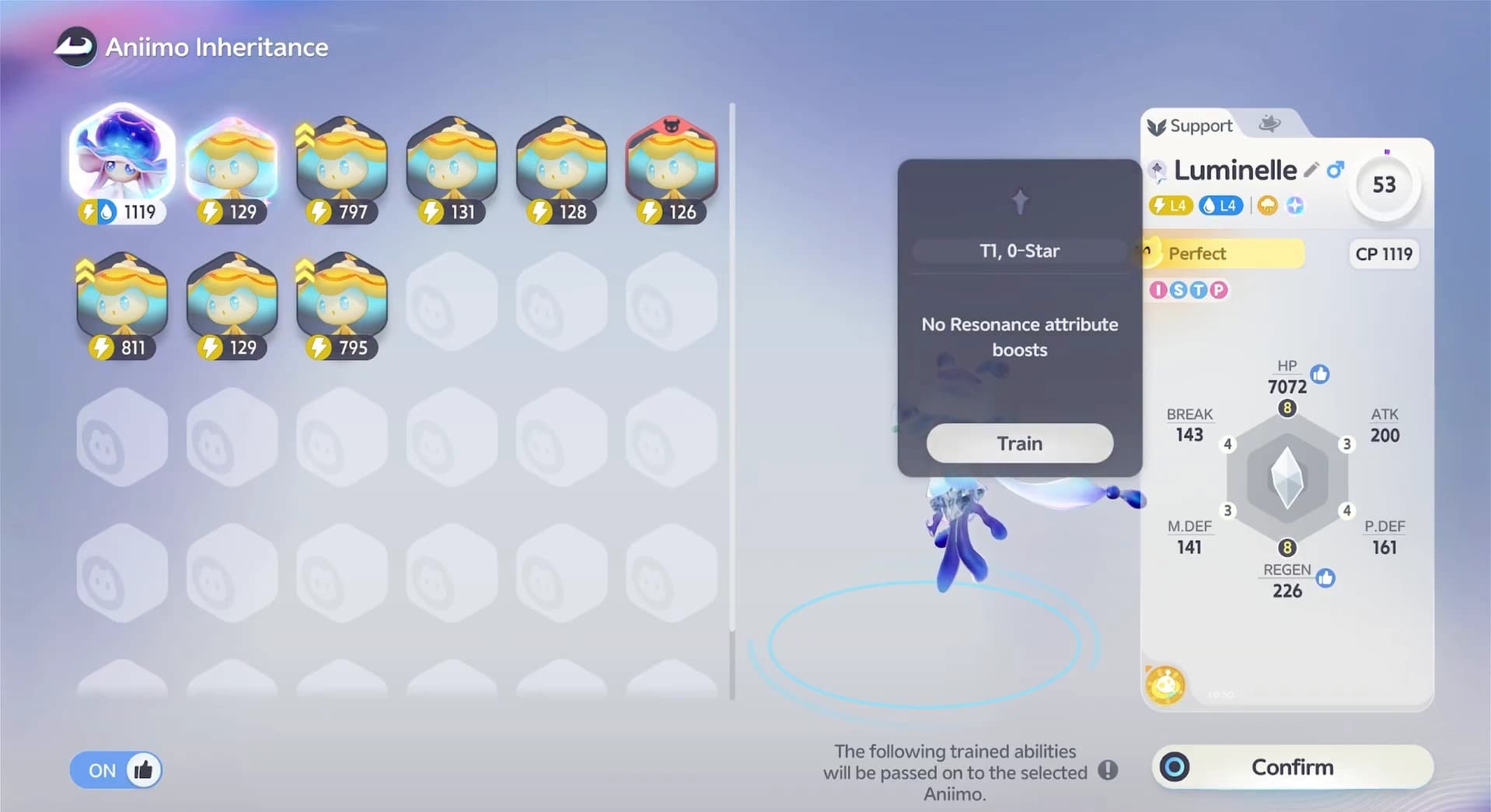
Level, Resonance stage and Star Rank, Capability Awakening progress and Capafruit all move across, and surplus growth items come back in full.
Inherit is refused while either Aniimo is sitting in a battle or exploration formation. Pull both out first.
You gift or swap an Aniimo with a friend
Companion Mode trading, tiered by how far the friendship has gone
The caps are on the Aniimo’s single best Potential value: the first tier allows up to 7, then 8, then 9, and the top tier allows a maximum potential of 10.
Each tier is tracked separately and each spends gifting attempts, so the top tier is not a tap you can leave running.
The Aniimo passes level 61
The reset button stops working
Nothing you have spent is lost, but nothing is refundable either. Decide the attribute spread before that point.
A free player’s order of spending
Materials run out long before the allowance or the ceiling does. Starcryst Essence is the scarce one, and 300 of it for a single fully maxed Aniimo is months of play, so the order below is about not burning it early.
- 1Pick one carry, then a second
Every point you spread across a bench Aniimo is a point that never reaches the team you actually clear content with. Two developed Aniimo beat six half-developed ones.
- 2Take both recommended attributes to 8 first
Points 1 to 8 on an attribute are Star Dust and Star Sand, which Alphas hand you for free. Finish that band on the two marked attributes before you open a single Starcryst Essence.
- 3Spend the Capafruit here
With the cheap band already done, the fruit’s six points land on the expensive rungs instead of the cheap ones.
- 4Push the recommended pair into the teens
Starcryst Essence goes into the two marked attributes and nowhere else until they are at 20. A third attribute at 12 is worth less than a second one at 20.
- 5Convert Star Shards as they arrive
Every 10 Star Shards is a free Starcryst Essence. Clear the exchange whenever you pass an outpost vendor.
- 6Reset before level 61, never after
If the build changed, 200,000 Credits buys the whole spend back. After level 61 the button is gone.
To decide which of two catches deserves the materials, put both into the Aniimo evaluator. It takes the six Innate values, the grade, the personality and your intended role, works out how much Acquired room each one has left and tells you which is worth keeping. The reasoning behind its verdicts is in how to evaluate an Aniimo, and the catching side of the problem, including which Aniipod to throw, is in the catching guide.
Frequently asked
What is the maximum Potential in Aniimo?
Innate plus Acquired Potential is capped at 20 on each of the six attributes, and Innate Potential on its own never rolls above 10. The cap is identical for every Aniimo, so rarity and grade change what the climb costs rather than where it ends.
How much does it cost to max one attribute?
From 0 Innate Potential, one attribute costs 10 Star Dust, 10 Star Sand and 50 Starcryst Essence. All six from a zero roll costs 60 Star Dust, 60 Star Sand and 300 Starcryst Essence. An attribute that started at 8 Innate pays no Star Dust and no Star Sand at all, because points 1 to 8 are the whole of that part of the bill.
Is the Potential Fruit worth using, and can I use two?
One Capafruit per Aniimo, and it grants +1 Innate Potential to each of its six attributes. It is worth the same on a Common catch as on a Perfect one, so spend it on whichever Aniimo you intend to take to 20 rather than saving it. Its effect transfers when you Inherit, so it is never stranded.
Can you reset Capability Awakening?
Yes, for 200,000 Credits, and the reset returns every material you spent. It stops working once the Aniimo reaches level 61, so make the call while you are still under the training level cap. A reset does not re-roll Innate Potential or change the Potential rating.
Does developed Potential carry through evolution?
It does. Evolving or changing form keeps both halves of every attribute, so time spent developing a first-stage Aniimo is never lost. The same package also transfers through Inheritance to another Aniimo of the same family, which is the usual way to move a trained profile onto a better roll.